
The Coalition and One Nation really want you to smoke more
Australia's right-wing parties aren't just rolling out policies that increase smoking rates and benefit the tobacco industry, but are also planning to use the funds for non-health related initiatives.

The Liberal-Nationals Party is claiming that cuts to the cigarette excise tax - a policy also supported by One Nation - will generate $8 billion to fund further cuts to the fuel excise tax when global price shocks drive up the cost of petrol. This is based on the idea that cutting the cost of cigarettes will drive revenue from the black market back into the government's coffers.
The problem? When you break down exactly what the Coalition's costing from the Parliamentary Budget Office says and consider the serious health risks of cutting the excise tax, it gets even shakier.
Michelle Jongenelis, director of the Melbourne Centre for Behaviour Change at The University of Melbourne , said when you make a product cheaper, such as when Canada cut taxes on cigarettes, smoking rates go up.
"You're making that product more affordable to the wider population. The other concern is that the modelling assumes that there is already a floor price for illicit tobacco," she said.
"These cigarettes can be bought for as little as a dollar a packet. The prices that we see on the market for illicit can go down even more and we are basically going to get illicit crime undercutting any changes that a government would introduce."
The Coalition assumed an 80% cut to the tobacco excise, a two-year trial period, $200 million for law enforcement and $60 million for an awareness campaign in its costings to the PBO. When the PBO returned a projection of $8 billion, it was driven entirely by the assumption that anyone currently purchasing tobacco illegally would shift back to legal market.
Professor Coral Gartner, an international expert in tobacco control policy at the University of Queensland, told me that "the most likely beneficiary of the proposed tax cut is the tobacco industry, not the government".
"Firstly, the Coalition don’t seem to understand what an 80% tax cut will do to the market – there is definitely no guarantee that people who are already buying from the illicit market would return to the legal market with even that level of tax reduction, some of our not-yet-published research suggests that most would not," she said.
"It is likely that the illegal price will simply drop too – the illegal traders can still make profit while undercutting the legal market with that proposed excise reduction.
"And then they have the problem of the consumers who are currently buying the taxed tobacco will be paying 80% less excise, so the policy is unlikely to make more money for the government. It could well drop revenue further. We also know from history that the tobacco industry are unlikely to pass on such tax cuts in full to consumers and there is nothing requiring them to do so."
One Nation has proposed a 75% reduction in the tobacco excise tax, and both parties claim this will stop organised crime in their tracks. If legal prices drop, so will the cost of buying cigarettes on the black market. Beyond this, the health cost of easier access to cigarettes has not been factored in at all.
Gartner said that taxing tobacco is primarily a health intervention used to discourage use, which leads to healthcare costs, lost productivity, less income tax when people have to retire early from tobacco-related disease, more disability pensions for the state and individuals.
As a result, "the Coalition’s motive here of trying to use tobacco customs duty to reduce the fuel excise is also problematic."
"Both the Labor government and the Coalition should be dedicating tobacco taxes to supporting people to quit smoking, paying for tobacco-related disease, disability pensions for people who can’t work due to tobacco-related disease, education programs to encourage quitting and prevent uptake and also support for retailers to get out of tobacco retailing," she said.
"The decline in smoking has accelerated since 2020, so you also have the issue of fewer people buying cigarettes if this trend continues. Government health policy is to try to decrease smoking rates as much as possible, so there is also a problem with the Coalition relying on tobacco taxes to fund promised future tax cuts, because tobacco tax should also be decreasing over time as fewer people smoke."
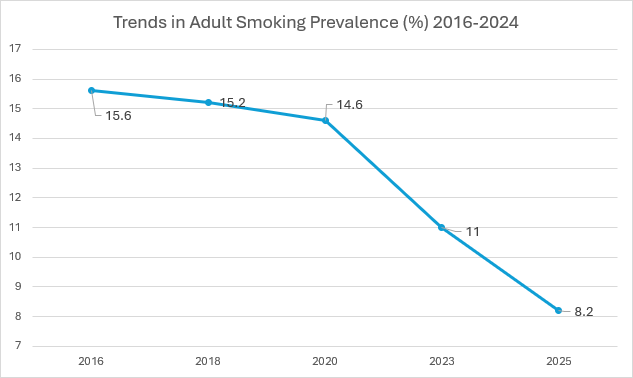
Statistics show that more than 50% of smokers now access illegal tobacco products rather than through legal means.
Jongenelis said that the easiest way to tackle organised crime and the illicit tobacco trade is reforming licensing and sales laws.
"We need to encourage people to quit cigarettes and support them doing that, rather than using the legal market," she said.
"We don't want, as public health advocates, people going from illicit cigarettes to the legal market."
Comments ()